9
Followers
27
Following

A Wholly Reluctant Blog
A blog by someone who prefers writing to writing about writing, but treats blogging like bad-tasting vitamins.
Currently reading

The Phantom Tollbooth

Ivanhoe
Cloud Atlas

Ishmael: An Adventure of the Mind and Spirit

Bulfinch's Mythology

Stars in Their Courses: The Gettysburg Campaign, June-July 1863

A History of Mathematics, Second Edition


 Persian history at the peak of the Achaemenid Empire (5th century BCE) is pretty neatly summed up in a few lines from our high school world history courses, largely in connection with Greek history. We hear a few snippets about the Persian rulers, Cyrus, Darius, and Xerxes; a big paragraph about the runner who sprinted from Marathon to warn the Greeks of the Persian attack (which was comeuppance for supporting a revolt in Persia and burning the city of Sardis) and ever after served as the namesake for future long-distance running contests; the battle at Thermopylae in which a handful of Spartans embarrassed an overwhelming Persian force under the Persian king, Xerxes, immortalized and buried under a mountain of hyperbole in cinema, and how Greeks won freedom from a terrible oppressor, launching democracy, serving as a basis for civilization and western world, blah blah blah.
Hyperbole. And partial nudity. And epic nose chains.
Essentially, most of what we know about Persia has been related through the lens of Greek history. The Persians amassed an enormous army and had an equally enormous empire, making them the perfect foil in the Star Wars parable that we've made Greek v. Persia history out to be.

Look, sir! Greeks!
It's a suitable mentality to have even in the current age, as the Persian empire stretched across the middle east, a land that is, and has been, largely unfriendly to the Western world for centuries, mostly for religious reasons (on both sides) that didn't exist during the Achaemenid empire.

Say, isn't this this pretty much the same empire Alexander ruled and was considered so awesome for creating, but promptly fell apart when he died?
The question that must come to mind to anyone reading this myopic history is: How did this empire come to be so massive and rich? Surely it could not have been all bad. Vidal's Creation answers this question and carefully explores what most folk of the Western hemisphere have deliberately ignored as a relic of the backwards and dangerous middle east: the Persian perspective.
What Vidal provides in Creation, from the viewpoint of the fictional diplomat and spiritual inheritor of Zoroastrianism, Cyrus Spitama, the grandson of none other than Zoroaster and childhood friend of Xerxes, is the story of a lush and powerful civilization, rife with power struggles and an abundance of history, just like the Greeks, and with ample justification for the contempt that Persians in power felt for the Greeks. And not without cause, as they're depicted as self-serving, filthy, shifty, and hardly trustworthy. Reading Creation, you're liable to share the Persian contempt. In many ways, and without stretching the truth, Spitama compares and contrasts Greek and Persian civilization, and it's difficult, in the end, to see how Greece receives the historical accolades while Persia is ignored. There's certainly a sense of foreboding and bitterness in Spitama as an old man recounting his journeys throughout the Persian empire, Greece, India, and China, who seems to know the wheels of fate have turned inexplicably in favor of Greek culture.
While much of Spitama's angst is directed at the Greeks, having metastasized from previous Persian rulers who had to deal with them, he also serves as a diplomat to the East as well. He visits and marries in India, is captured in China, and meets figures of extraordinary historical significance.
It's important to note that Vidal has selected a singularly remarkable time period and location to explore, in which the likes of significant eastern historical figures, such as Siddhartha Guatama (the Buddha), Master K'ung Fu-tzu (Confucius), Lao Tse (creator of the Tao Te Ching), were mucking about in the East at the same time prominent Greeks and Persians were mucking about in the "West". Not only do we meet these philosophical titans, we get to listen to their followers interact and deride one another, which is an unparalleled treat.
Much of the greatness I attribute to this story has little to do with Vidal's writing ability, which itself is slick as wet glass in the reader's mind, and more to do with Vidal's selection of time period. Volumes and volumes and volumes of books have been written on each of the characters in this work, on the empires explored (including those lesser-known in India), on the political machinations of those in power (including Zoroaster himself, which provided Spitama with an important political role where he otherwise might have been No One). But to combine this confluence of activity and personality seamlessly into a single novel is all at once an obvious choice, a fascinating exploration of that which most overlook, and ultimately nothing short of sublime.
 A reading experience is a reflection of the reader and what is taken away is largely a function of what the reader brings with them to the book. That said, I found this nonfictional work daring, dramatic, a tad wordy, but ultimately satisfying in a The Government Regulatory Committee Is Doing Its Best Not to Let Me Blow Myself, Property, or the Environment to Pieces sort of way.
Thanks for that.
 Rand should be applauded for, if nothing else, taking convention and turning it on its head. Government gone wild in an effort to maintain control is nothing new, particularly to anyone familiar with George Orwell. And anyone with a general grade-school education is, I'm guessing, familiar with George Orwell. But Orwell, et al, chose to depict the common dynamic of the powerful oppressing the non-powerful. Rand, however, chooses to depict the wealthy, the entrepreneurs, the successful, generally people we consider powerful, as those who are oppressed.
This is a challenging position to accept, perhaps because as readers, and consumers of media in general, we've been trained to identify with the first dynamic. The powerful oppressing the non-powerful is a familiar theme, probably because it's so easy to understand. Children subject to bullies; employees with overbearing bosses. The theme repeats itself in reality everywhere and at all levels. We see this theme repeated in fiction and non-fiction. We love the story of the overmatched, underpowered underdog triumphing over the stronger opponent. There's little to compel readers to read a story about a superpower stubbing out smaller opponents. It's a challenge to derive any sense of tension in scenarios where everything happens as expected.
In Atlas Shrugged, Rand has created a world in which the powerful are crippled by the weak by, essentially, electing officials that destroy opportunities for success in the name of equality. This hurts everyone, which is the point Rand tries to make, and the only way for the weak to avoid suffering is to allow the strong to be successful. This smacks of trickle-down economics, which ultimately failed (is failing?) after being put into place.
The theme is also challenged by the fact that, while many in the US rail against a society of entitlement for underachieving citizens supported by government giveaways, regulations that put the clamps on (arguably dangerous) corporate practices, companies have also been granted the status of citizens, receive billions of dollars (this offhand approximation is probably a gross understatement) in government subsidies, have merged resources to the point that the failure of one can endanger the national and even world economy (something that would surely give American Badass and trustbuster extraordinaire, Theodore Roosevelt, fits) and spend countless dollars lobbying in Congress for laws supporting their business--a capacity that normal citizens decidedly lack. Whichever side you take on Rand's stand, there's evidence for both sides of the argument because government has taken both sides, which is itself likely unsustainable.
As ridiculous as this premise may seem (to me, anyway), Rand had little choice but to put forth the most extreme, slippery slope scenario to make her point. How else does one write a treatise for a position without exploring the undesired situation to its deepest depths? The plight of Sisyphus isn't half as interesting if he's pushing his stone along level ground. The goal is always to make the slope as close to vertical as reasonable.
In the end, this is a very, very long book with a theme you can derive by reading the first chapter and giving some thought to the title within the context of that chapter. Essentially: what would happen if the world economy was driven by a handful of innovators and those people, shouldering the whole world, shrugged, ending their contributions? Answer: the world would fall into the abyss. Or whatever Atlas was preventing the world from falling into by holding it on his shoulders, which is itself debatable as an imagined threat because Atlas was made to hold the planet ([sic] it was actually the heavens) as punishment, implying it had, at some point, not been supported by a god.
I appreciated some of Rand's descriptions. She could be an evocative writer when she wasn't using Objectivism as a bludgeon. I also appreciated the strong character of Dagny Taggart, but most others are such absurd caricatures that it's hard not to think of the work as satirical. I suppose in a universe of possibility that this kind of situation is possible, too, but in the end I don't think the odds currently rest in favor of the non-powerful. As much as we enjoy underdog stories, what makes them special is they are so rare--those with ample resources tend to win almost exclusively.
For all the hubbub over this book, I give it a "Hmm" for presenting an interesting twist on a common theme and considering the obstacles faced by the producers/Prime Movers of the world, but a "Meh" for the story itself. The story might have been more compelling with the inclusion of a Teddy Roosevelt character.

But what story wouldn't be?
My earliest recollections of this book are a mix of the blurred stars of the book jacket, the original airing of the PBS series, and its connection to my father. Considering I was only 3 years old at the time, this strikes me as an indication of its import. What I remember distinctly are sitting beside the couch and watching with my father as a long DNA strand stretched out across the television screen and images of the hardbound book in my father's personal library.A few years after the first run of this series on PBS, my father died. Cosmos always held a certain fascination for me, as a book, as I identified it with my father, but I never read it. Not until a few years ago. Perhaps just to see what my father saw, or to learn what brought the book and series such reverence.
Oh, and what a world.
Inspirational, life affirming, and filled with starry-eyed wonder, Sagan's magnum opus pleads the case for science as the preferred lens through which to see the world. Written in a time when humanity seemed to teeter on the brink of mutually assured destruction, Sagan argued for rational behavior, for the unity of humanity and absurdity of petty power struggles, for the scientific method as a way to interpret events around us rather than prominent pseudosciences (e.g., astrology) with tenets that seemed deliberately vague and arbitrary (and surprisingly easy to debunk, given their popularity), how we benefit from being skeptical, and the great potential of the human race.
This book earns my unadulterated praise for building upon a philosophy that human beings can do well for themselves if they'd bother considering their ridiculous behaviors and learn how to act sensibly. The potential is there, as evinced by the leaps made by individuals throughout human history. Whether or not we choose to stand upon the shoulders of giants, or cower in their shadows, remains to be seen.
I like to believe that this was a philosophy my father shared and would have taught me firsthand if he'd been around. It's a philosophy I feel I adopted anyway, and, as a result of this similarity, I want to believe in some way a bit of him is preserved in me.
But don't just read the book. To get the full experience, watch the PBS series released in 1980, narrated by Sagan himself and scored by Vangelis (later known for Chariots of Fire, The Last of the Mohicans,and Blade Runner, to name a few, but his breakthrough, and one of his best works, remains one of the themes to the 1970 French documentary on the animal kingdom, L'Apocalypse des animaux, la petite fille de la mer).
There's a reason Cosmos is the most widely viewed PBS Series in the world. Beautifully stated and brilliantly scored, it tells the story of humanity, our universe, and how we fit within it.
On a personal level, it is a bridge back to my father, an inspiring philosophy, a source of wonder regarding how our world might evolve if the portions of ourselves that influence what is best in us are lost, and whether or not we can avoid disaster long enough to fully realize our potential in spite of ourselves.
If you can't read the book, or watch the series, do yourself a favor and, at the very least, watch this.
ADDENDUM:
It has come to my attention that an updated version of this landmark series will be hosted in 2014 by none other than Neil deGrasse Tyson, entitled COSMOS: A SpaceTime Odyssey. The trailer shows the new version is very true to the original, with Sagan's infamous Cosmic Calendar, the spaceship of the mind, Johannes Kepler, and several other memorable moments from the 1980s series.
 As the son of Hollywood and Broadway funnyman Mel Brooks, one would expect a book by son, Max, to be rife with the same over-the-top, bawdy and side-splitting humor for which his father is notorious. Especially considering the subject of choice: Zombies.
Brooks' previous effort was a comprehensive Zombie Survival Guide which outlined how the common North American civilian could survive zombie attacks on a small scale, as well as how to survive the catastrophic possibility of worldwide infection (by Brooks' reckoning, zombieism is a condition brought on by the virus Solanum, not reanimation by dark, supernatural forces).
In his latest work, World War Z: An Oral History of the Zombie War, the absolute worst has come to pass. Through ignorance, miscommunication, unpreparedness and sheer negligence, the entire world has been overrun by the living dead.
Yet instead of a comic rendition of zombies roaming the earth and being systematically wiped out by the oft-cast, steely-eyed and determined Hero, we are given a vivid recounting of humanity in a war for survival against the overwhelming hordes of undead which very nearly wipes the living human race from the face of the earth.
Brooks presents this history in a series of interviews with principle characters across the globe in a conflict that has lasted, and in some respects continues, for ten years. These interviews are grouped into chapters from the initial detection and outbreaks, to reactions from numerous governments which vary from mobilization to denial to isolation to complete ignorance, through the conflict and the aftermath as the world rebuilds. Those who have survived to offer interviews show the effects of the conflict in very visible ways, from those who are psychologically shattered to those who discover something new and purposeful about themselves when before their value was negligible. They are very often unheroes, with little social worth or self-respect, who rose to the occassion when the world fell under attack.
Throughout, Brooks emphasizes the changes from the world as it was: political disunity, racial and class discrimination; to the world that it has become: unified in the purpose of survival, then victory.
It highlights the wastefulness of government, the shattering of the social structure (who needs actors, entertainers or athletes in a world where survival is paramount?), and the galvanization of the entire species with the purpose of achieving a single goal. The book essentially states, without ever saying as much, that the near extinction of humanity by the living dead is the best thing that could ever have happened, returning a sense of urgency and purpose to a very sedentary people. The book is a statement on how the dominant species of our planet is, in truth, extremely vulnerable.
This book is not utterly without humor, though the younger Brooks does not express it in the same explicit fashion as his father. There are various, subtle references to movies (Ghostbusters), cartoons (Transformers), video games (Myth) and even his own Survival Guide (which is snubbed by one interviewee as "clearly written by an American") which only someone who has come into contact with them will catch. Yet these humorous instances are downplayed because the main thrust of this book was not comedy, as booksellers would lead you to believe.
Perhaps this oral history was created with ironic, comic intentions, but the message it conveys is one of very serious warning. We are a fractured people full of needless bile, and if we could but work together rather than focus upon our differences there is no obstacle we cannot overcome. But if we choose to remain stubborn, indignant and hateful, ignorant of one another and our respective cultures, we will almost surely be swallowed up by whatever disasters, be they zombies or otherwise, which lurk just around the corner.
 Susanna Clarke's first offering is an innocuous champion amongst books, made all the more so by the author establishing a reader's expectations for bland, Victorian prose and the gentlemanly tropes you'd expect from a Jane Austen novel. Nevertheless, the novel is magically compelling: it hooks a hand into your belt buckle and pulls you along for a splendid renaissance of English magic and a fascinating look into the history of the once proud tradition and leading figures.
In reading Clarke's novel one gets the sense of a greater world just beyond the view of the normal, as though the populace has developed a form of mystic-blocking cataract, and that old world can only be seen by looking through a prism of magical knowledge. Magic is an undercurrent undetectible to most, like a third dimension to the residents of Flatland, but it is incontrovertible presence for those who know where, and how, to look.
Clarke depicts magic as a droll hobby for well-to-do-but-nothing-better-to-do Englishmen, who deem magic is something fun to discuss in a nigh-university setting, but not something that can, or should, be practiced. Magic, like many practices that have perished before it (alchemy, divination, et al), and other similar bogus means of robbery should (astrology, fortune telling, mutual funds), is doomed to become obsolete as a practice. That is, until the reclusive Mr. Norrell decides to prove magic is real. How he does so is neither a Gandalf-slays-Balrog, nor a Harry-Potter-magic-wand-bolt, nor anything so showy and conspicuous, but is nevertheless powerfully convincing, and is made so solely by the strength of Clarke's prose. Without Clarke and her ability to write, the scene simply doesn't work.
And this is the strength of the entire book: Clarke's ability to construct relatively unspectacular scenes that come screaming to life on the back of her writing. Couple this with extensive entries and anecdotes on the history of English magic (which include frequent references to the book's most fascinating, enigmatic, and invisible character: The Raven King, who is purportedly the greatest magic-using, non-magical-creature ever) contained largely in footnotes that often eat up the better part of a page, and you have a universe of characters, history, and events that Tolkien would have been proud to call his own.
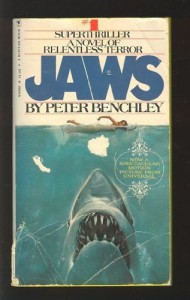 Tedious. For a book involving a shark killing people on a resort beach, there's quite a bit of content regarding marital discontent. It's not fair to this book that I saw the movie first and frequently, which offers a tight narrative, a lot of tension, and some great character interaction. The book offers melancholy rooted in marrying below one's class. I found this kind of disdain an irritating distraction of a side story that torpedoed the whole experience exploded the shark for me.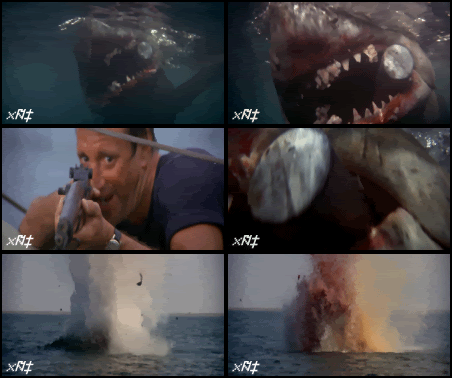
This is a more fitting metaphor.
While being disgruntled might be a genuine symptom of such marriages (even though cinema is notorious for trying to make you believe otherwise), I didn't understand what it was doing in this book. Class conflict would have been much better articulated between Flint and Hooper, which is a point the screenwriter (surprise!) clearly agreed with.
The rating here is buoyed by the fact that it inspired the Spielberg film, and because I always hum "Farewell Spanish Ladies" to myself whenever I go out on a boat... which really doesn't mean anything for the book, but means I'm thinking about the movie again.
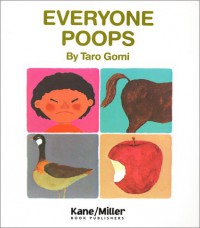 This book is responsible for asking the most haunting unanswered question I have ever confronted:
What does whale poop look like?
Easily the most enjoyable book I've ever read, with Watership Down putting in a strong second-place finish. Certainly the best ever in telling, and spinning anew, the centuries old Arthurian legend. Gone are the old stories relayed in stark and monotonous detail, replaced by characters bursting with vitality.The story benefits greatly from White's knowledge of medieval culture, Thomas Malory's Le Morte d'Arthur (review here), whose influence is credited directly in The Book of Merlyn, occasionally affected and quirky dialogue, infrequent intrusions of contemporary fact (the 1950s, both from White and Merlin's perspective), and fascinating observations on human nature. But what makes the book truly sing are the titanic, troubled, and heroic characters, all striving in vain in favor of an ideal that ultimately cannot be supported due to a myriad of tiny failings inherent in the human condition.
The story teems with elements that readers of all ages can appreciate: a bit of history, a bit of love, a bit of learning, a bit of humor, a bit of bitterness, hope, miracles, and an ending that leaves you with an understanding that the ending only takes us back to the beginning, and that perhaps Arthur will have a second and better chance.
The effort required not to enjoy a book of this caliber is certainly as rare and extraordinary as the book itself.
Easily the most enjoyable book I've ever read, with Watership Down putting in a strong second-place finish. Certainly the best ever in telling, and spinning anew, the centuries old Arthurian legend. Gone are the old stories relayed in stark and monotonous detail, replaced by characters bursting with vitality.The story benefits greatly from White's knowledge of medieval culture, Thomas Malory's Le Morte d'Arthur (review here), whose influence is credited directly in The Book of Merlyn, occasionally affected and quirky dialogue, infrequent intrusions of contemporary fact (the 1950s, both from White and Merlin's perspective), and fascinating observations on human nature. But what makes the book truly sing are the titanic, troubled, and heroic characters, all striving in vain in favor of an ideal that ultimately cannot be supported due to a myriad of tiny failings inherent in the human condition.
The story teems with elements that readers of all ages can appreciate: a bit of history, a bit of love, a bit of learning, a bit of humor, a bit of bitterness, hope, miracles, and an ending that leaves you with an understanding that the ending only takes us back to the beginning, and that perhaps Arthur will have a second and better chance.
The effort required not to enjoy a book of this caliber is certainly as rare and extraordinary as the book itself.